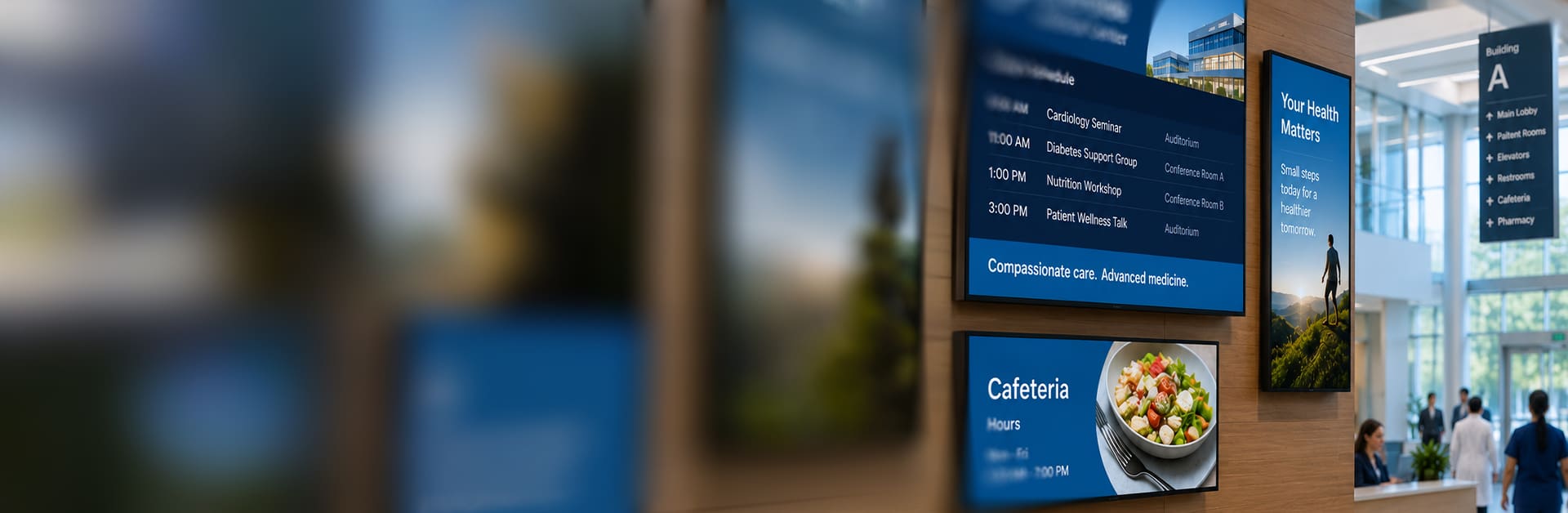
Digital signage is often underestimated because most people see only the display. They notice the screen on a wall, the message in a hallway, or the information board near an entrance. What they do not always see is the communications platform behind it and the role that platform can play in managing information across a large environment.
That distinction matters in healthcare and campus settings. These are environments where communication has to be timely, visible, and relevant to different audiences throughout the day. Patients, visitors, staff, students, faculty, and administrators all move through shared spaces with different needs and different expectations. Static messaging is rarely enough. Organizations need a better way to manage what is displayed, where it appears, how quickly it can change, and how consistently it can be controlled.
That is why ALTO deserves to be viewed as more than a collection of screens. It is better understood as a centrally managed communications platform that helps organizations inform, engage, and coordinate across multiple endpoints. For IT leaders and operations teams, that changes the conversation from simple signage deployment to communication strategy, platform governance, and operational control.
Why Digital Communication Has Become More Operationally Important
In healthcare and education, communication is part of the operating environment. It influences how people move through facilities, how they receive timely information, and how the organization maintains consistency across a broad set of locations. A display is not useful simply because it is visible. It is useful when it delivers the right information in the right place at the right time.
That need has only grown as facilities have become more dynamic. Healthcare organizations are expected to support patient communication, staff awareness, visitor guidance, and internal messaging across spaces that are constantly changing. Educational institutions face similar demands across campuses, buildings, common areas, and specialized environments where audiences shift throughout the day. In both cases, the communications layer has to be managed as part of the larger operational experience.
This is where traditional signage approaches often fall short. If content updates are difficult, if visibility across displays is limited, or if teams cannot manage communications centrally, the platform creates more overhead than value. What begins as a simple messaging tool can quickly become another fragmented system that requires too much manual effort to keep current.
A stronger model treats signage as part of the institution’s digital communications strategy. That means governance, visibility, remote management, and content flexibility matter just as much as the screens themselves.
Why ALTO Is More Than a Display Solution
ALTO is compelling because it is positioned as a software-based communications platform rather than only a hardware category. Netsync describes ALTO as a SaaS platform that enables organizations to collaborate, interact, and inform across multiple endpoints using rich media, interactive video, and chat technologies. That positioning is important because it reflects a broader use case than static digital signage alone.
For IT teams, this means ALTO should be evaluated as a managed communications environment. The question is not just what the screen can show. The question is how the organization controls content, manages endpoints, supports interaction, and maintains consistency across many displays and locations. That is a much more meaningful operational discussion.
The platform view also matters because communication needs change over time. A healthcare network may need to update information by facility, department, or audience. A campus may need to coordinate messaging across student centers, classrooms, administrative buildings, and event spaces. In each case, the value of the system depends on whether it can support changes efficiently and without excessive manual coordination.
By framing ALTO as a centrally managed experience platform, the conversation becomes much more relevant to enterprise IT and communications teams. It is no longer just about screens on walls. It becomes about how information is delivered across the institution in a way that is visible, manageable, and aligned to the environment.
Why Centralized Management Matters So Much
One of the strongest operational advantages of a digital communications platform is centralized control. The more locations and endpoints an organization supports, the more important it becomes to manage content, configuration, and visibility from a common administrative point of view.
In practice, this affects almost everything. If content updates require too many manual steps, messaging becomes inconsistent. If teams cannot quickly confirm what is running on specific displays, troubleshooting becomes slower. If policy and configuration are difficult to manage remotely, the overhead of supporting the environment increases. These may seem like administrative concerns, but they shape whether the platform remains sustainable as it expands.
Netsync highlights ALTO’s ability to provide visibility into displays and content, support remote configuration, and enable policy management through ALTO Digital Manager. That matters because it gives organizations a stronger foundation for operational consistency. IT and communications teams are not forced to manage every endpoint as a separate effort. They can work from a more coordinated view of the environment.
This is especially important in healthcare and campus settings because distributed communications are rarely static. Messages may need to change based on time, location, audience, or operational conditions. A centrally managed platform gives organizations a better way to respond without creating unnecessary delay or support burden.
Why Healthcare and Campus Environments Need Flexibility
Healthcare and education both place unusual demands on communication platforms because they are multi-audience environments. Different groups move through the same spaces with very different needs. Visitors may need directional guidance. Staff may need operational updates. Students may need event information or campus messaging. Patients may need timely, easy-to-understand content in waiting or care environments.
A one-size-fits-all communications model does not work well in settings like these. What matters is flexibility. The organization needs a way to deliver rich, location-aware communication that can be adjusted without rebuilding the platform every time priorities change.
This is part of what makes ALTO more useful than a narrow signage system. Netsync describes support for personalized experiences, rich media, interactive applications, and third-party content. That gives the platform broader communication value. Instead of functioning only as a passive display layer, it can become part of a more responsive and engaging digital environment.
For IT leaders, that flexibility is also a governance advantage. A platform that supports evolving communication needs without requiring fragmented workarounds is easier to scale and easier to manage. It gives the institution room to improve how information is delivered without having to treat every new communication need as a separate technology decision.
The Technical Value for IT and Operations Teams
For technical teams, the real value of a digital communications platform comes down to manageability. A strong platform should reduce complexity, not add to it. That means browser-based administration, centralized visibility, remote control, policy support, and a structure that allows endpoint growth without multiplying support challenges.
ALTO’s SaaS model is especially relevant in that context because it shifts the conversation toward centralized management and serviceability. When platforms can be administered and monitored more consistently, organizations are in a better position to maintain standards across large and diverse environments. That is valuable in healthcare systems, campus networks, and other multi-site organizations where the communications layer needs to remain reliable without becoming a drain on IT resources.
Netsync also emphasizes ALTO’s support for APIs and third-party content. That matters because communication platforms are often more useful when they can align with broader institutional systems and information sources. Even without turning the platform into an over-engineered integration project, that flexibility helps organizations avoid creating a digital signage environment that becomes isolated from the rest of their operations.
This is where ALTO becomes particularly relevant for IT professionals. It is not simply a content display tool. It is a platform that can support governance, visibility, and more coordinated communication across a distributed institution.
Why Better Communication Infrastructure Supports Better Experiences
It is easy to think of signage as a finishing touch rather than infrastructure. In reality, communication systems shape how people experience an environment. Clear, timely messaging reduces confusion, supports engagement, and helps organizations present information in ways that are more useful and more consistent.
In healthcare, that can improve the experience of patients, visitors, and staff by making communication more visible and responsive. In educational environments, it can help institutions communicate across larger and more dynamic communities without relying on fragmented channels alone. In both settings, stronger communication infrastructure supports smoother daily operations.
That is why the platform behind the screens matters so much. If the institution cannot manage the experience centrally, adapt messaging efficiently, or maintain visibility into the environment, the value of the displays stays limited. When the platform is designed to support coordination and control, the communications layer becomes far more useful.
This broader perspective also helps explain why ALTO should not be treated as just another endpoint category. It supports an experience strategy. It gives organizations a more structured way to deliver digital communication that is scalable, manageable, and aligned to the demands of real environments.
A Better Way to Think About Digital Signage
The most useful way to think about digital signage in healthcare and campus settings is not as a screen project. It is as a communications platform that needs to be managed with the same discipline applied to other shared technology services. The institution needs visibility, remote control, policy support, flexibility, and enough central management to keep the experience consistent over time.
That is what makes ALTO stand out. It shifts the focus from isolated displays to coordinated communication. It gives IT and operations leaders a stronger foundation for managing content, endpoints, and engagement across distributed environments. Just as importantly, it does so in a way that fits the realities of healthcare and education, where communication demands are broad, dynamic, and operationally important.
When digital signage is treated as part of a larger communications strategy, the value becomes much clearer. The organization gains more than screens. It gains a more manageable and more responsive way to inform the people who depend on it every day.
FAQ
What is ALTO?
ALTO is a digital communications platform designed to help organizations inform, engage, and interact across multiple endpoints using centrally managed content and experiences.
Why is ALTO more than digital signage?
Because it is positioned as a SaaS platform that supports rich media, interactive applications, centralized management, and broader communications coordination rather than only static screen content.
Why is centralized management important for digital communications?
Centralized management helps organizations maintain consistent content, configure displays remotely, improve visibility, and reduce the manual effort required to support large environments.
Why is ALTO especially relevant in healthcare and education?
Because those environments depend on timely, visible, and flexible communication across multiple locations, audiences, and operational needs.
The best digital communication platforms do more than fill screens. They help organizations create clearer, more connected experiences across the environments people rely on every day. If that sounds like a conversation worth having, Netsync’s ALTO Digital Signage team would be glad to explore it with you.


