How to Choose a Managed Cybersecurity Provider
Two proposals can promise around-the-clock protection and still leave your organization with very different levels of support. One may deliver investigated incidents with an agreed containment process. Another may send alerts to your team and leave the next decision to whoever is available.
For executives comparing managed cybersecurity services, that difference deserves more attention than a product list. The central question is whether the proposed service covers the work your organization needs, with clear ownership when something goes wrong.
Choosing a cybersecurity provider starts with defining those requirements. Then you can compare scope, test response procedures and evaluate the full cost against the same expectations. The following framework gives CTOs, CISOs and business leaders a practical way to make that comparison before signing an agreement. Bring security, IT operations and business stakeholders into the review early so the final scope reflects how your organization will actually manage an incident.
What should managed cybersecurity services include?
Managed cybersecurity services provide ongoing security capabilities through an outside team under an agreed scope. Depending on the engagement, that scope may include security monitoring, alert investigation, detection tuning, incident escalation and authorized response actions. The contract should establish which activities are included and where the provider’s responsibilities end.
Ask for a service description that follows an issue from detection through closure. It should identify covered systems, staffing hours, investigation depth, communication methods and the evidence you receive. If a proposal promises incident response, find out whether that means advice, remote containment, forensic investigation or hands-on recovery support.
Also look for operational maintenance. Who notices a disconnected log source? Who updates detection rules when applications change? Who checks whether integrations still work after an upgrade? Monitoring depends on those less visible tasks, so they need owners too.
Netsync’s managed security services bring together technology, protocols and security personnel to detect, analyze and respond to cybersecurity alerts. When evaluating any provider, connect that operating model to the specific responsibilities documented in your proposed engagement.
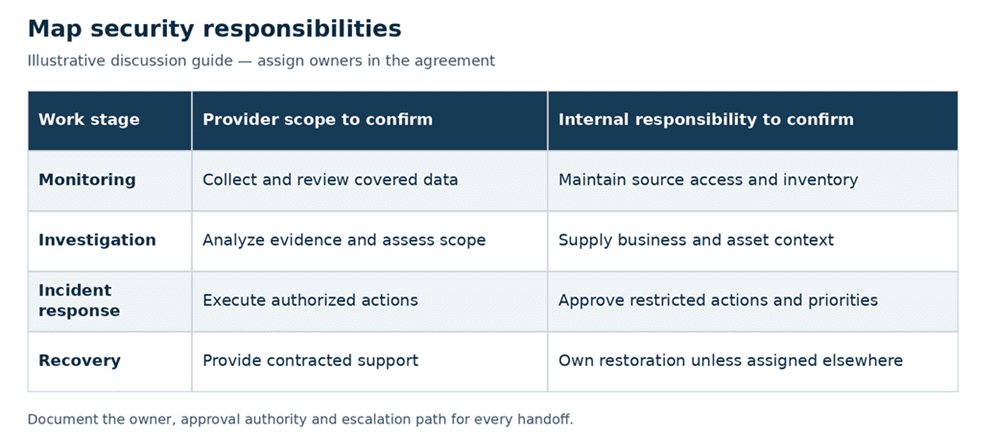
Illustrative responsibilities to confirm in the service agreement.
Use the coverage map to discuss ownership, then build a detailed responsibility matrix into the service documentation. Assign an accountable owner to every handoff; a task marked “shared” still needs someone responsible for moving it forward.
Define the coverage your business actually needs
Begin with the services your business cannot afford to lose and the systems that support them. A customer portal, clinical application or payroll platform may require different response decisions from a standard employee workstation. Document those priorities before asking providers to recommend a package.
Build an inventory of the environments that need coverage: endpoints, identities, email, network infrastructure, cloud accounts and business applications. Include branch locations and remote users. Identify systems that cannot support standard agents or integrations, and ask how the provider would address those gaps.
Next, describe the work your team already performs well. An organization with experienced incident responders may need overnight investigation and escalation. A smaller team may need broader operational support. Cybersecurity managed services should address those staffing and capability gaps without creating uncertainty about who does what.
Give shortlisted providers the same requirements, including:
- Critical systems, operating hours and business consequences of disruption.
- Current security tools, available log sources and known visibility gaps.
- Internal staffing, after-hours availability and approval authority.
- Data retention, access and reporting needs identified with relevant stakeholders.
Require each provider to mark requirements as included, optional, unsupported or dependent on customer action. Ask what changes if an integration is unavailable. This creates a useful comparison and exposes assumptions that might otherwise survive until onboarding.
Examine the provider’s own access model as well. Ask how privileged access is approved, limited, logged and removed, and how subcontractors are governed. Request appropriate assurance evidence for your review, while checking its scope and date. A certification or assessment covering one business unit may not cover the service you are buying.
Compare responsibilities, response, and escalation
A service description becomes more useful when you test it against a realistic incident. Ask every finalist to walk through the same hypothetical case, such as a compromised administrator account outside business hours. Have them explain what their analysts see, what they investigate, who gets called and which actions require permission.
Listen for specific handoffs. A strong explanation identifies decision makers, communication channels and the next step when someone does not answer.
Monitoring versus investigation and response
Security monitoring watches covered data sources for suspicious activity. Investigation adds context: whether activity is expected, which accounts or assets are involved and how serious the issue may be. Response involves actions to manage the incident, potentially including containment, eradication and coordination with recovery teams, as the engagement permits.
Ask the provider to demonstrate the difference using a sanitized sample case. What evidence accompanied the alert? What did an analyst confirm? Which actions were completed, recommended or handed back to the customer? Ticket volume alone cannot answer those questions.
Technology should support that workflow. Security information and event management, or SIEM, helps bring security data together for analysis. Security orchestration, automation and response, or SOAR, can coordinate tools and automate approved workflows. Netsync’s SIEM and SOAR solutions address those capabilities, but a platform’s features do not establish what a managed service contract includes.
Verify who maintains integrations and playbooks, what actions can run automatically and how exceptions are handled. Request a clear distinction between software capabilities, services included in the subscription and separately priced assistance.
Escalation procedures should specify severity levels, primary and backup contacts, notification channels and what happens when the customer is unreachable. For urgent cases, ask how the provider confirms a human received the message and whether an alternate communication channel is available if company email is affected.
What your internal team still owns
Outsourcing security work leaves important decisions inside the business. In its 2025 incident response guidance, the National Institute of Standards and Technology (NIST) describes third-party involvement as a shared responsibility model and emphasizes establishing the division of responsibilities and information flows.
Document ownership of business decisions, system changes and recovery. Your organization may retain responsibility for patching, identity administration, backups, legal review and stakeholder communications unless those activities are explicitly assigned elsewhere. Confirm the actual arrangement rather than assuming a standard division.
Containment authority needs particular care. Disabling an account or isolating a server may interrupt a critical service. Agree in advance which actions are preauthorized, which need approval and who can make an urgent exception. Keep the approval process accessible to both teams.
Understand pricing, exclusions, and service levels
Compare total operating cost across equivalent coverage. A subscription priced per endpoint may exclude log storage, onboarding or incident response hours. Another may charge by data ingestion, making cost sensitive to new applications or changes in logging. Ask each provider to model your current environment and a realistic growth scenario using documented assumptions.
Request a written list of service exclusions and additional charges. Examine support for legacy systems, custom integrations, threat hunting, forensic work, on-site assistance and recovery. Check whether emergency support requires a separate agreement, minimum purchase or activation fee.
Security SLAs, or service-level agreements, should define measurable commitments by severity. Distinguish acknowledgment from investigation, notification and action. A quick ticket acknowledgment tells you little about when an analyst starts assessing the threat.
For every material commitment, clarify:
- What event starts the clock and what event stops it.
- Which hours, systems and incident categories are covered.
- Whether waiting for customer approval pauses measurement.
- How exceptions, missed targets and service credits are handled.
- What records allow you to verify performance.
Avoid treating an average response time as a contractual guarantee. Ask how averages are calculated and how outliers are reported. Also distinguish a commitment to initiate containment from a promise to resolve an incident; restoration may depend on systems and teams outside the provider’s control.
Review data access and exit terms before signing. Determine who can export logs, investigation records and detection content, in what format and at what cost. Document retention, deletion, transition assistance and how access will be revoked when the relationship ends. Include your procurement and legal teams in that review.
Use a provider evaluation scorecard
A scorecard helps a buying committee compare evidence consistently. Set the criteria and weights before reviewing final proposals so an appealing presentation does not redefine the decision.
The graphic below offers a starting point. Adjust the weights to your risks and staffing needs; they are suggested evaluation priorities, not an industry standard. Score each category from zero to five and calculate weighted points as the rating divided by five, multiplied by the category weight.
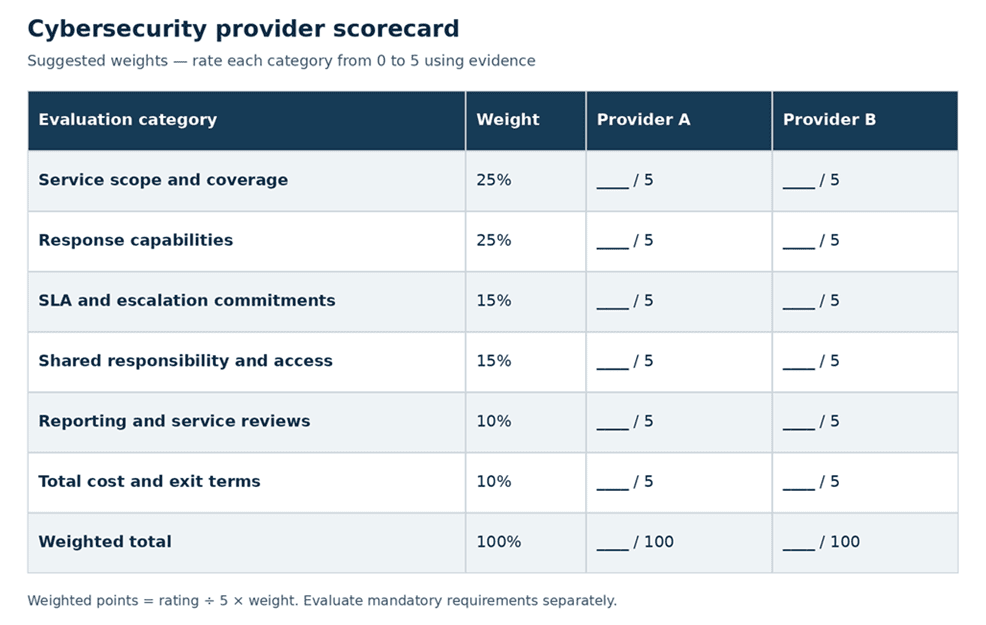
Suggested comparison framework. Weights are adjustable; no provider scores are implied.
Use a consistent evidence scale: zero means no evidence; one means a verbal assertion; two means partial documentation; three means documented coverage that meets the requirement; four adds a demonstrated workflow; five adds validated fit through an agreed exercise or pilot. Record the supporting document or demonstration alongside each rating.
Keep mandatory requirements separate from the total. If continuous human investigation is essential, a provider that cannot deliver it should not advance because it scores well on cost or dashboards. The same applies to an unsupported critical application or an unacceptable data access restriction.
For finalists, request a sample incident report, an escalation walkthrough and a proposed responsibility matrix. Where practical, validate agreed capabilities through a controlled pilot with defined success criteria. Obtain permission for testing and use approved test data rather than creating uncontrolled activity in production.
Resolve material gaps in the written scope before selecting your managed cybersecurity provider. A high score is useful only when the underlying evidence matches the service you will receive.
Plan onboarding and ongoing service reviews
The evaluation should end with a credible implementation plan. Ask for a sequence that covers discovery, access provisioning, integrations, log validation, detection tuning, contact testing and operational acceptance. Name an owner on each side and identify customer dependencies that could delay coverage.
Establish acceptance criteria before the service goes live. These might include confirmed data from priority systems, successful test alerts, verified escalation contacts and documented response permissions. Record uncovered systems and interim arrangements so leadership understands the remaining gaps.
If replacing a provider, coordinate the transition before ending the existing service. Confirm when the new team can investigate activity, how open incidents will transfer and whether required records can be exported. Define any overlap needed for validation and revoke old access after the agreed handoff.
Then set a review cadence that fits the engagement. Examine coverage health, investigation and escalation performance, unresolved incidents and changes in the environment. Ask for explanations of missed targets and assigned corrective actions. Reports should help you decide what to improve, with owners and dates for follow-up.
NIST’s incident response guidance also identifies exercises with relevant third parties as a way to prepare participants and evaluate performance. Use a tabletop exercise to test the people and decisions behind the documented process, especially after significant changes in personnel or systems.
The right agreement gives your organization a working relationship it can explain and verify: covered systems, assigned responsibilities, measurable commitments and a tested path from an alert to action. That is a firmer basis for choosing a provider than a promise of comprehensive protection alone.
Put your security coverage requirements into focus
Discuss your security coverage requirements with Netsync. Start with your critical systems, existing tools and response responsibilities to identify the support your organization needs.
Frequently asked questions
What is included in managed cybersecurity services?
Managed cybersecurity services can include ongoing security monitoring, alert investigation, detection tuning, incident escalation and authorized response. Coverage varies by agreement. Confirm supported systems, staffing hours, reporting and responsibility for maintaining integrations. Forensics, recovery, on-site assistance and other specialized work may require separate services, so request a written scope and exclusions list.
What should a managed cybersecurity SLA specify?
A managed cybersecurity SLA should identify covered services and hours, severity definitions, measurable response commitments and escalation procedures. It should explain when measurement begins, which dependencies can pause the clock, how performance is reported and what remedies apply. Separate acknowledgment, investigation and notification commitments from containment actions or resolution targets.
How do you evaluate a provider’s incident response capabilities?
Request a documented response workflow, a sanitized incident report and a walkthrough of a realistic scenario. Verify analyst involvement, containment authority, escalation contacts and coordination with your internal team. Test agreed procedures through a tabletop exercise or controlled pilot when practical, and confirm which response activities are included in the contract.


