What Does an IT Implementation Partner Actually Deliver?
A technology implementation proposal should make it clear what your organization will receive, how the work will be validated and who will take responsibility afterward. A list of equipment, software and engineering hours leaves too much open to interpretation.
For CEOs and CTOs, the useful question is what those resources will produce: an approved design, functioning integrations, documented test results and an environment your team can operate. Those deliverables give you a basis for evaluating both the proposal and the finished project.
Technology implementation services turn an agreed design into a working environment through planning, configuration, integration, testing and handoff. The exact scope varies. Before approving a project, establish what each stage includes and what your organization must contribute to keep it moving.
What does an IT implementation partner deliver?
An IT implementation partner coordinates the technical work and project activities needed to put a solution into use. Depending on the agreement, this may include discovery, solution design, staging, deployment, migration, acceptance testing, training and documentation.
Each activity should produce something you can review. Discovery should establish requirements and constraints. Design should show how the solution will work. Deployment should leave a record of what was installed or configured. Testing should provide evidence that agreed requirements were met.
Project management connects those activities. It identifies dependencies, tracks decisions and gives stakeholders a way to resolve issues before they affect the schedule. Netsync’s implementation project management supports project delivery across its technology practices, with an emphasis on communication and coordination tailored to the customer’s environment.
Ask any prospective partner to identify the person accountable for delivery and the process for reporting progress. A useful update distinguishes completed work from work awaiting approval, highlights risks and identifies decisions the customer needs to make. Percent-complete figures need that context to support a business decision.
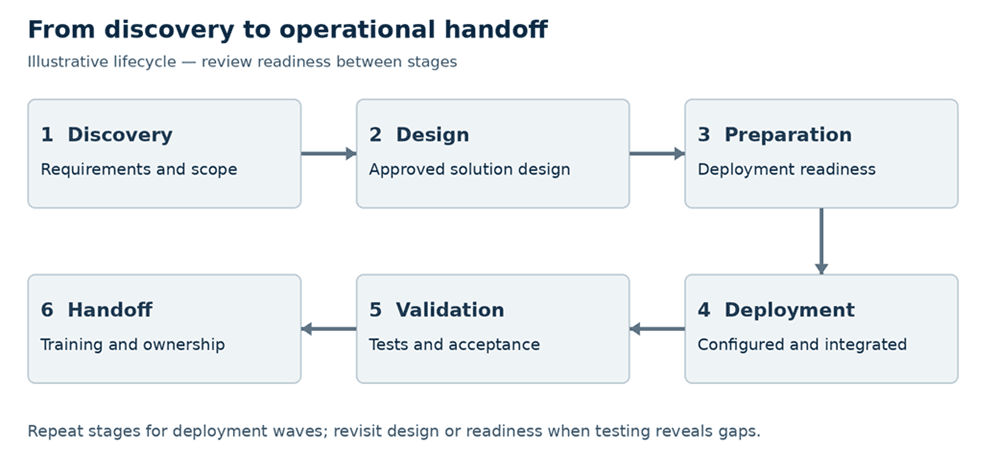
Illustrative lifecycle with review points between stages.
The technology implementation process may repeat these stages for different locations or deployment waves. The sequence should fit the project’s dependencies, with review points that confirm readiness before the next major step.
Assess requirements and define project scope
Start with the operational problem and the result the business needs. “Replace the wireless network” describes an activity. Defining the locations, device types, applications and coverage requirements makes the work specific enough to design and evaluate.
Discovery should examine the current environment, relevant configurations and the constraints that could affect deployment. Depending on the project, these may include site access, available power, cabling, licensing, application dependencies or third-party schedules. Confirm which findings the partner will verify and which information your team must supply.
The statement of work should translate those findings into clear boundaries. Look for:
- Included systems, locations, integrations and deliverables.
- Exclusions, assumptions and customer responsibilities.
- Milestones, approval points and schedule dependencies.
- Acceptance criteria and the process for resolving incomplete work.
Be particularly careful with assumptions. If a proposal assumes existing cabling is suitable, ask who validates that assumption and what happens if it is wrong. If application owners must participate in testing, reserve their time before the schedule becomes a commitment.
Define how project scope changes will be handled. A request to add another site may affect engineering, equipment, travel and testing. The change process should document those impacts and identify who approves the revised cost or timeline before additional work begins.
Design the solution and prepare for deployment
Design explains how the proposed environment will meet the requirements. Useful deliverables may include architecture diagrams, configuration specifications, integration dependencies and a migration approach. The level of detail should match the complexity and risk of the project.
System integration deserves explicit attention. Ask how the new environment will interact with identity services, monitoring platforms, business applications and existing infrastructure. Name the owner of each interface. Confirm who will troubleshoot when components work independently but fail together.
Security and operational requirements should inform those decisions before deployment. Identify administrative access needs, logging requirements, backup arrangements and configuration standards. In its Guide for Security-Focused Configuration Management of Information Systems, the National Institute of Standards and Technology (NIST) treats security as an integral part of configuration management. For a project team, that supports addressing security within design and change review rather than leaving it for a final check.
Preparation also includes practical readiness. Hardware may need staging, software may need approved versions and licenses may need activation. Verify site access and required infrastructure before scheduling installation. Ask for a readiness review that records unresolved dependencies and gives each one an owner.
Use a pilot when it can meaningfully test the approach. A representative location or user group can expose compatibility issues before a broader rollout. Define what the pilot must demonstrate and how its findings will affect later deployment waves.
Implement and validate the environment
Implementation should follow the approved design and deployment plan, with a record of changes made along the way. If the team discovers a condition that requires a design adjustment, document the decision and obtain the appropriate approval. An unexplained difference between the design and installed environment becomes a support problem later.
Ask how engineering work will be coordinated with your internal change management process. Technical change control covers the review, approval and tracking of system changes. Organizational change management addresses how people prepare for new tools or workflows. A project may need both, with different owners and deliverables.
Progress reviews should show what has been deployed, what has been tested and which defects remain open. Those are different measures of readiness.
Acceptance testing and success criteria
Acceptance testing checks the delivered environment against requirements agreed by the customer and implementation partner. Establish the test plan early enough to influence design, staffing and the deployment schedule.
Specify the test conditions, expected results, evidence required and person responsible for signoff. Include representative business workflows alongside technical checks. For example, an illustrative branch-network project might test whether authorized users can access required applications, whether guest traffic remains separated and whether monitoring receives the expected alerts.
The partner may prepare and execute technical tests, while your IT team and business users validate operational fit. Assign those responsibilities in writing. Identify who has authority to accept the work and how third-party application owners will participate.
Agree how defects affect acceptance. Define which issues block go-live, how lower-priority items are tracked and who approves any temporary exception. Record remediation owners and dates, with retesting where needed. A deadline alone should not determine whether an unmet requirement is acceptable.
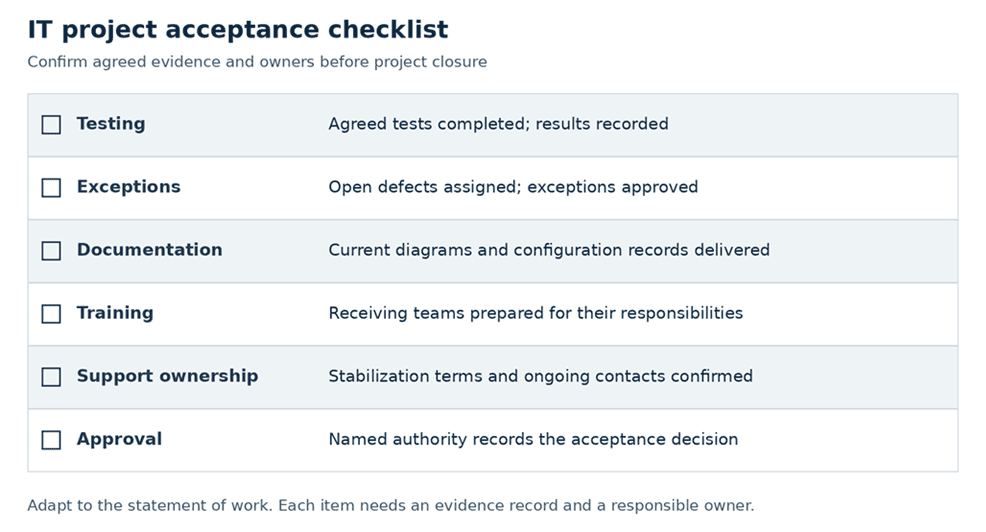
Suggested checklist to adapt to the agreed project scope.
Cutover planning and rollback
Cutover is the move from the existing environment to the new one. The plan should identify the work sequence, maintenance window, communication responsibilities and decision maker for proceeding or stopping.
Rollback planning establishes how the team would return to an agreed prior state if defined conditions are not met. Ask what can actually be reversed. Changes involving new transactions or migrated data may require reconciliation or a recovery approach beyond restoring an old configuration.
Set decision thresholds before the maintenance window. Identify the latest practical time to reverse course, the required backups or configuration copies and the checks needed afterward. Review the plan with the people who must execute it, including any third parties whose availability is essential.
Complete training, documentation, and handoff
Operational handoff should leave your team able to manage the environment and find help when needed. The project documentation should reflect what was actually deployed, including approved changes made during implementation.
Request deliverables appropriate to the solution: current diagrams, configuration records, asset and license inventories, operating procedures and an open-issues log. Store administrative credentials through an approved secure process, with access assigned to the right owners rather than embedded in general project documents.
Training should match responsibilities. Administrators may need maintenance and troubleshooting guidance, while employees may need help completing changed workflows. Specify the intended audience, format and materials. Give the receiving team an opportunity to practice important tasks and raise questions before project closure.
Confirm the boundary between implementation and ongoing support. Identify any stabilization period, its duration, included activities and escalation contacts. Document who handles monitoring, patching, backups, support cases and future changes after that period ends. Resolve any gap between the project team’s departure and the start of another support agreement.
Longer-term ownership also requires accurate records of assets, contracts and refresh needs. Netsync’s technology lifecycle management services address inventory review, contract management and planning for technology upgrades. Discuss that work separately from the implementation scope so ongoing responsibilities and costs remain clear.
Questions to ask before approving a proposal
A sound proposal should let you trace the business requirement through design, delivery and acceptance. Before approving IT implementation services, ask questions that test those connections:
- What specific deliverables will we receive, and who approves each one?
- Which assumptions and customer dependencies could change the schedule or price?
- Who owns integration work and coordinates third-party participation?
- What tests demonstrate readiness, and which defects prevent acceptance?
- How will cutover decisions, rollback and unresolved issues be managed?
- What documentation, training and support ownership remain after closure?
Request written answers where the proposal is unclear. Check whether travel, after-hours work, licensing, migration assistance and post-launch support are included. Ask how additional work is priced and how payment milestones relate to agreed deliverables. Compare proposals against the same scope so a lower estimate does not conceal work your team will still need to complete.
The project is ready for approval when both sides understand the work, the evidence of completion and the responsibilities that continue afterward. That clarity helps leaders make a more informed investment and gives the implementation team a practical definition of done.
Plan your next technology deployment with Netsync
Discuss the scope of your next technology deployment. Bring Netsync your requirements, existing environment and operational priorities to start a conversation about project delivery and handoff.
Frequently asked questions
What is the difference between implementation and ongoing support?
Implementation is a defined project that puts an agreed solution into use through activities such as design, configuration, integration, testing and handoff. Ongoing support covers specified operational needs after deployment. An implementation agreement may include a limited stabilization period, but monitoring, maintenance and future changes require clearly assigned responsibilities and may need a separate agreement.
What deliverables should an implementation proposal include?
An implementation proposal should identify project scope, deliverables, exclusions, assumptions, customer responsibilities, milestones and pricing. It should also explain design documentation, integration work, testing, cutover planning, training and operational handoff as applicable. Request acceptance criteria, a process for scope changes and a clear description of support available after go-live.
Who is responsible for acceptance testing?
The customer and implementation partner should agree on responsibilities before deployment. The partner may prepare and run technical tests, while customer IT staff and business users validate requirements and workflows. The agreement should name the acceptance authority, define required evidence and explain how defects, exceptions and retesting are handled.


