Managed NOC Services vs. an In-House Operations Team
At 2 a.m., a branch loses connectivity. Monitoring sends an alert, but the engineer on call is already handling another outage. Someone still has to determine what failed, contact the carrier, update the business, and stay with the incident until service returns.
That sequence is where the choice between managed NOC (network operations center) services and an in-house operations team becomes practical. Both models can work. The better fit depends on the coverage your business needs, the expertise available during an incident, and the responsibilities your organization wants to retain.
For a useful comparison, start with the same operating requirements for each option. Otherwise, a managed service quote may look expensive beside a salary budget that leaves nights, vacations, and escalation work unaccounted for. Or it may look inexpensive because the proposed service stops at notifying your team.
What do managed NOC services provide?
Managed NOC services give an organization access to a provider’s network operations center, or NOC, under an agreed service scope. Network operations center services typically center on monitoring infrastructure health, assessing alerts, and coordinating or performing an agreed response. The contract determines which systems and actions the provider covers.
Netsync’s network operations center provides centralized monitoring and management across environments that can include fiber, wireless, data centers, and applications. When evaluating any provider, turn that general capability into a specific inventory of supported assets, monitoring requirements, and authorized actions.
An alert-only engagement differs substantially from one that includes troubleshooting, approved remediation, and carrier coordination. Ask whether the provider can investigate a failing link, make an authorized configuration change, open a support case, and follow the case through restoration. Identify exclusions before comparing prices.
Also separate network operations from cybersecurity monitoring. A network outage can have a security cause, but buying NOC coverage does not establish that threat investigation or containment is included. Define how the operations team hands a suspected security incident to the appropriate security owner.
Compare coverage, staffing, and accountability
An internal team brings knowledge that takes time to document: which location cannot tolerate an interruption, which application behaves poorly during maintenance, and who can approve a change after hours. Keeping operations in-house can make sense when that context is central to daily troubleshooting and the organization can sustain the required staffing.
The constraint is often coverage. One continuously staffed position requires 168 hours each week. Dividing that by a 40-hour workweek produces 4.2 full-time equivalents before allowing for leave, training, meetings, or unexpected absences. That calculation covers one seat; it does not establish sufficient staffing for simultaneous incidents or specialist escalation.
An on-call rotation is a different model. Engineers may respond outside their normal hours without continuously watching a queue. If that meets the business requirement, compare it with a managed offering that provides equivalent response expectations. Avoid treating on-call availability and an actively staffed shift as interchangeable.
Outsourced network operations can extend coverage without requiring your organization to recruit every shift itself. Still, ask how the provider handles overlapping outages, shift handoffs, and escalation to senior engineers. A coverage statement tells you when service is available; it doesn’t fully explain who can act.
Consider a hypothetical branch outage. The NOC sees a failed circuit, the carrier wants local testing, and the internal network lead is unavailable. Who contacts the site? Who approves a failover change? Who tells the business when connectivity returns? Walk through those decisions together. The answers expose operational gaps more reliably than a generic demonstration of the monitoring dashboard.
Use a responsibility matrix to assign each action. Keep one named owner responsible for advancing the incident, even when several teams contribute.
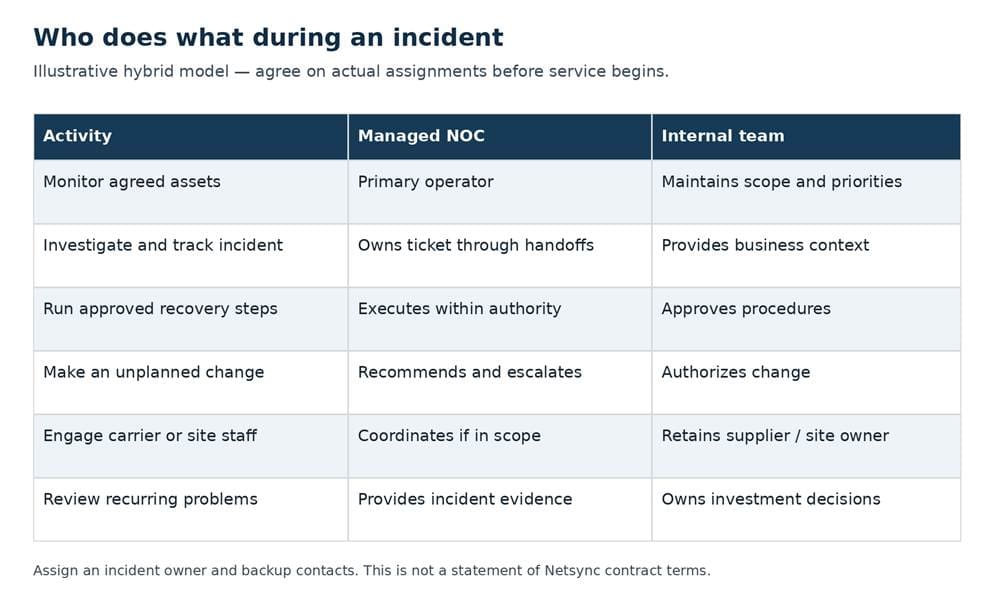
Illustrative responsibility assignments; confirm in the agreement.
Model the full operating cost
A managed NOC vs in-house comparison should use a common time horizon and the same requirements. Start with an annual view, then separate first-year transition expenses from recurring costs. If device counts or locations will grow, model that growth on both sides.
Staffing, tooling, training, and coverage
For an internal model, include fully loaded compensation, recruiting, shift coverage, and the management time needed to run the operation. Add monitoring licenses, ticketing, integrations, training, and any specialist support the team relies on. Count shared costs only to the extent they support this work, and distinguish allocations from expenses you can actually eliminate.
For the managed model, use the quoted recurring fee and identify its pricing basis. A per-device agreement may behave differently from one priced by site or service tier. Ask how new locations, unusual incident volumes, additional integrations, and work outside the agreed scope affect the bill.
Keep retained internal labor visible. If engineers must approve changes, maintain documentation, resolve escalated problems, or manage the provider, include those hours. A lower staffing requirement does not automatically translate into payroll savings when the same employees remain with the business.
Time returned to engineering projects can still be valuable. Describe it separately as capacity available for other work, and identify the projects that could use it. That keeps the business case credible without assigning speculative savings to every hour.
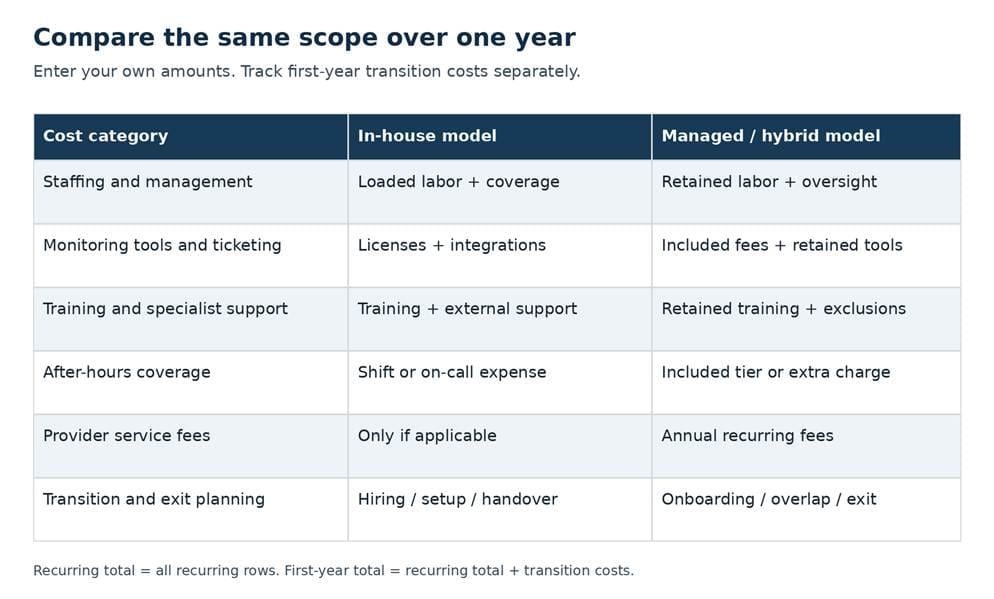
Planning worksheet; enter organization-specific costs.
Transition and retained internal responsibilities
Onboarding can require substantial internal effort. Someone must reconcile the asset inventory, verify monitoring credentials, document dependencies, and agree on escalation paths. Allow for a period when the existing operation and the new service overlap while both teams test the handoff.
Include contract exit work, too. Determine how you would retrieve configurations, ticket history, monitoring data, and operating procedures. Establish who removes provider access and how coverage continues during a transfer. The same questions apply when bringing an outsourced function back in-house.
CISA’s Risk Considerations for Managed Service Provider Customers makes a central point: outsourcing IT services does not remove the organization’s risk management responsibilities. Translate that principle into named internal owners for service priorities, risk acceptance, and provider oversight.
Connect daily operations to the service lifecycle as well. An accurate alert means little if a failed device has no usable support entitlement or nobody has planned its replacement. Netsync’s lifecycle management services address technology planning and contract management, including contract information that affects support cases and service levels. Determine how that information will reach the team handling an incident.
Evaluate access, escalation, and reporting
A provider needs enough access to perform its assigned work. Start by identifying the actions each role requires, then establish how access is approved, reviewed, and removed. Discuss emergency access before an outage creates pressure to improvise.
NSA’s guidance for managed service providers and their customers recommends multifactor authentication for provider accounts accessing customer environments, monitoring account activity, and disabling unused accounts. Ask a prospective provider to explain how these practices apply to your environment and who can review the evidence. Require clear security responsibilities in the agreement.
Escalation deserves equal attention. Document severity definitions, contact methods, backup contacts, and the point at which the provider involves an internal engineer or another supplier. If the primary contact doesn’t answer, the incident should follow an agreed path rather than wait indefinitely.
Read service levels closely. Acknowledgment time measures how quickly someone accepts an alert or ticket. Restoration measures when service returns. These are different commitments, and a fast acknowledgment doesn’t establish a restoration guarantee. Ask when each clock starts, which exclusions apply, and how the provider records dependencies on carriers or customer approvals.
Then review a sample incident report. You should be able to follow the timeline from detection through diagnosis, escalation, and recovery. Look for records of actions taken, approvals requested, and the reason for delays. Agree on how the team confirms recovery before closing the ticket.
Monthly reporting should help you make decisions. Repeated circuit failures may justify a carrier review. Recurring alerts after maintenance may point to a configuration problem or thresholds that need adjustment. Request reporting that connects incident patterns to corrective actions, with an owner and a review date, rather than stopping at ticket totals.
Decide where a hybrid operating model fits
A hybrid arrangement assigns selected operational responsibilities to a provider while the internal team retains others. It can fit an organization that needs after-hours coverage but wants its engineers to lead architecture, application integration, and major network changes.
For example, a provider might monitor agreed infrastructure around the clock, investigate alerts, and carry out documented recovery steps. Internal engineers could approve changes outside those procedures and handle problems that require deeper business context. That division works only if the provider has usable instructions and someone remains available for decisions it cannot make.
Be careful with a handoff that sends every meaningful action back to the same overloaded engineer. The service may improve detection while leaving the underlying response bottleneck intact. Review a sample of expected incidents and determine how many the provider could advance independently within its authority.
An in-house model may remain the stronger choice when the organization already has dependable coverage, specialized operational requirements, and enough management capacity to sustain the team. A managed model may fit better when recruiting and shift coverage constrain service delivery. Hybrid operations deserve consideration when the gap is narrower than the full operating function.
Build your NOC evaluation checklist
Before requesting proposals, document what your current operation actually handles. Review recent incidents, identify coverage gaps, and speak with the teams affected by outages. Use that evidence to set requirements you can apply consistently to an internal staffing plan and an external proposal.
Your evaluation should answer these questions:
- Which assets and business services are in scope, and how will the inventory stay current?
- What coverage is required, and what happens during simultaneous incidents?
- Which actions can the operations team perform without additional approval?
- Who owns the incident through restoration, including work with carriers and other suppliers?
- What access controls, records, and reporting will your organization retain?
- What are the recurring costs, transition expenses, retained staffing needs, and exit obligations?
Ask the people who would deliver the service to work through an outage scenario with your engineers. Test contact paths, change approvals, and reporting expectations before transferring responsibility. Resolve any disagreement about ownership while the service is still being designed.
Choose the model that your organization can operate consistently. The strongest proposal will show how people, procedures, and spending meet your requirements during an ordinary week and during the outage that arrives when your most experienced engineer is unavailable.
Discuss your network operations coverage
Netsync can help you explore centralized network monitoring and management alongside your internal operating requirements. Discuss your network operations coverage with our team to identify the scope and responsibilities your organization needs.
Frequently asked questions
Does a managed NOC replace the internal IT team?
Not necessarily. A managed NOC can take on defined monitoring and response work while internal IT retains architecture, business priorities, change approvals, and provider oversight. The staffing impact depends on the agreed scope and the responsibilities that remain inside the organization.
What is the difference between a NOC and a service desk?
A NOC focuses on infrastructure health and network operations. A service desk is a point of contact for users reporting problems or requesting IT services. Their work can intersect, so define how user reports reach network operations and how updates return to affected users.
How do you compare managed and internal operating costs?
Price equivalent coverage and scope over the same period. Include internal staffing, tools, training, and coverage expenses. Compare those with provider fees plus retained internal labor, onboarding, integrations, and potential out-of-scope work. Separate recurring spending from transition costs and distinguish cash savings from engineering capacity returned to other projects.
Can a managed NOC provide only after-hours coverage?
Some providers offer arrangements designed around specific coverage gaps. Confirm the hours, supported systems, response authority, and handoff process in the proposed agreement. Daytime and after-hours teams need access to current incident records and the same escalation procedures.


