Workload Placement Strategy for Business Applications
The infrastructure refresh is due next year, but the application decision cannot wait that long. Finance wants a cost forecast. Operations needs better recovery. The application team wants to keep a database close to the system it exchanges transactions with all day.
Each concern is reasonable. The challenge for IT leaders is deciding which approach serves the business without creating costs or responsibilities the organization cannot sustain.
A workload placement strategy provides a basis for that decision. It connects where an application runs with what the business needs and what IT can reliably operate. The answer may be on premises, in the public cloud, or a hybrid design that combines the two. Sometimes the soundest decision is to leave an application where it is until another system changes or a replacement becomes available.
You don’t need to settle every architecture detail to lead the discussion. You do need clear answers about performance, risk, operations, and cost before approving the investment.
What workload placement means for IT leaders
Workload placement is the decision about where an application and the resources supporting it will run. Those resources include its data, network connections, security controls, and the services it depends on. Moving the application while leaving its database elsewhere creates different operating conditions from moving both together.
That distinction matters because a hosting proposal can look attractive in isolation and become less convincing once the rest of the application enters the picture. A lower infrastructure estimate may come with slower transactions, additional support responsibilities, or a difficult migration.
Consider a hypothetical inventory application that exchanges information throughout the day with a local transaction database. The business could keep both on premises, move both to the cloud, or separate them across environments. None of those choices is automatically superior. Each needs to meet the same business requirements.
Before comparing them, establish the conditions an acceptable solution must meet. These might include approved data locations, vendor support, licensing terms, and the ability to operate during an internet outage. An option that fails a mandatory requirement needs revision before it becomes a credible candidate.
The decision tree below illustrates that sequence: establish which options can meet the requirements, then compare their costs and tradeoffs.
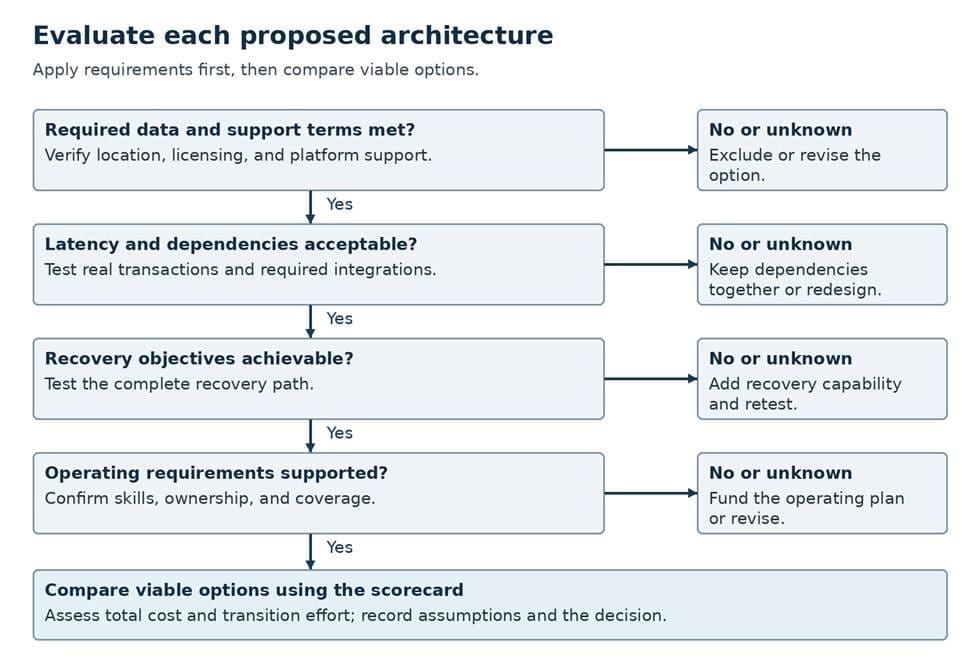
Illustrative decision process. Confirm requirements before comparing viable options.
Performance that supports the business
The first question is whether employees and customers can do their work at an acceptable speed. A system that runs successfully in a new environment may still respond too slowly during a busy operating period.
For the inventory application, the critical issue is its relationship with the database. Separating the two could add delays each time they exchange information. If a single user action requires repeated exchanges, those delays can accumulate. A faster connection with more bandwidth does not necessarily remove the wait between requests.
Your technical team should establish whether that matters for the proposed design. The executive discussion should stay anchored to the business effect: can employees complete the transactions they need, including during known peaks? A demonstration during a quiet week offers limited reassurance if the application struggles during month-end processing.
Application dependencies also affect the scope of the decision. Moving the inventory system may require changes to connected services, which could alter the timeline and business case. Leaders need visibility into those dependencies before committing to a destination or migration date.
The useful evidence is a performance result tied to an agreed business requirement. A broad claim that an environment is faster or more scalable cannot answer whether this application will work well there.
Risk the organization can accept
Where an application runs affects how the organization protects its information and restores service. Neither a company-owned data center nor a cloud platform removes the need to make those decisions.
Start with the consequences of an interruption. How long could the inventory application remain unavailable before operations suffer? How much recent transaction data could the business afford to lose? Those answers establish recovery expectations and help determine what protection is worth funding.
NIST’s contingency planning guidance distinguishes the target time for restoring a system from the point in time to which its data must be recovered. For executives, the practical value of that distinction is simple: restoring service quickly and preserving recent transactions are separate requirements. A proposal should explain how it addresses both.
A hybrid design also needs careful scrutiny. Distributing components across locations does not automatically improve resilience. If the application still depends on one database, identity service, or network connection, that dependency can interrupt the business process even when other components remain available.
Our enterprise cloud storage solutions include backup, replication, and recovery support. When considering those capabilities, keep the approval discussion focused on the complete service: what can fail, what protection the proposal provides, and what recovery testing demonstrates. Restoring a database alone does not prove employees can resume work.
Operations your team can sustain
A placement decision commits the organization to an operating model as well as a technology platform. Someone must maintain access, oversee performance, manage changes, and respond when the application fails outside normal hours.
Cloud and managed services can take over defined tasks, but your organization still needs to understand its responsibilities. Application configuration, integration support, and decisions about data protection may remain with your team. The service agreement should make those boundaries clear.
For the inventory example, keeping the application on premises may fit existing skills. Moving it could require training or outside support. A hybrid arrangement could require coordination across both environments. These are considerations to fund and manage, rather than reasons to favor one model in every case.
The question for leadership is whether the proposed operating plan is realistic. If it depends on capabilities the team has yet to develop, the proposal needs time and budget for that work. During an outage, it should also be clear who leads the response and coordinates suppliers. Otherwise, a design that looks manageable on paper can leave the business waiting while teams debate ownership.
Cost over the life of the decision
The cheapest hosting estimate may not represent the lowest cost of delivering the application. Compare options over the same planning period and require each to provide the agreed performance, protection, and support.
For an on-premises design, the comparison should account for equipment, software, facilities, staffing, and future refresh needs. For cloud, it should include the services the application will actually consume, along with licensing, data movement, support, and recovery resources. Prices and contract terms need current verification.
The distinction between allocated cost and avoidable spending deserves particular attention. Moving the inventory application will not eliminate the cost of a data center that must remain open for other systems. Savings depend on which expenses the organization can actually stop paying.
Migration adds another layer. Discovery, testing, training, parallel operation, and retiring the old environment all require effort. An application approaching replacement may not have enough useful life left to justify that investment.
Ask how the cost changes during a business peak or recovery event, and what it would take to change direction later. These questions make the business case more useful than a comparison based only on normal monthly consumption.
Make the recommendation easy to evaluate
A workload placement assessment should give executives a clear recommendation with reasons they can examine. The scorecard below illustrates how a team might compare the inventory application’s three options. Its entries are hypothetical prompts for evidence, rather than rankings of on-premises, cloud, and hybrid hosting.
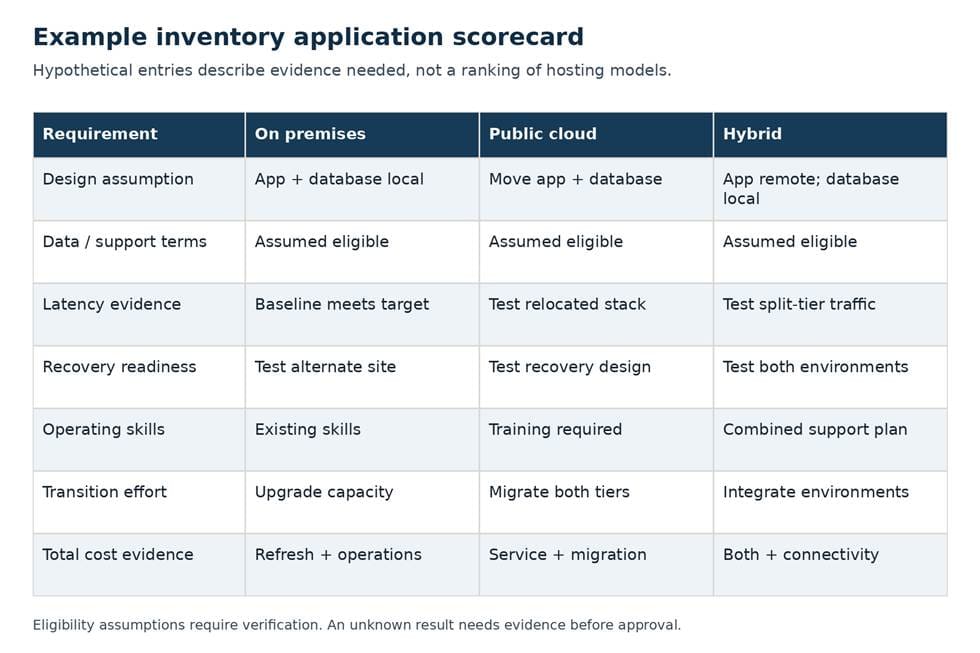
Hypothetical example. Verify assumptions and unresolved requirements before approving a design.
The value lies in making the tradeoffs visible. If moving both application and database offers advantages but requires substantial migration work, the recommendation should explain that investment. If separating them leaves performance unproven, the uncertainty should remain visible until testing resolves it.
Netsync’s hybrid and multi-cloud solutions support cloud readiness, migration, optimization, and management. We help organizations evaluate those choices in the context of their business requirements.
The final decision should identify the selected approach, the alternatives considered, and the assumptions that would change the recommendation. A major renewal, infrastructure refresh, or change in demand may justify another review. Keeping those triggers explicit helps the organization revisit placement when there is a business reason to do so.
An effective application hosting strategy leaves leadership able to explain why the application belongs where it runs, what the organization is committing to, and how that choice supports the business.
Discuss your application placement strategy
Netsync helps organizations evaluate cloud readiness, migration, optimization, and management needs. Talk with our team about aligning application performance, recovery, operating responsibilities, and cost with your business priorities.
Frequently asked questions
What should executives consider in a workload placement strategy?
Focus on business performance, acceptable risk, operating responsibilities, and total cost. Confirm that each proposed option meets mandatory requirements before comparing its advantages with the alternatives.
Should every application use the same hosting model?
No. Applications have different dependencies, demand patterns, recovery needs, and useful lifespans. Standard platforms can simplify operations, but the selected approach still needs to serve each application’s business requirements.
Does hybrid cloud automatically improve resilience?
No. Applications can depend on a shared database, identity service, or connection even when their components run in different environments. Evaluate recovery for the complete business service rather than assuming that distribution makes it resilient.
When should leaders reassess application placement?
Revisit the decision when its assumptions materially change. Infrastructure refreshes, major renewals, acquisitions, new data requirements, or sustained changes in demand can justify another assessment.


